Friday, April 29, 2011

The first casting


Ixobrychus minutus
Molding in wax, real size of the bird


This is the beginning of the three-dimensional process of the work. The main part (the bird) has been molded in wax. Once the piece is cast, it will be assembled on a metallic structure.


Sketches of Ixobrychus minutus
Graphite pencil on paper, 24 x 48 cm.


The beginning of every sculptoric project is based on drawing.
On the left upper corner of the second page of sketches of Ixobrychus minutus there is an outline of the assembling of the piece.

Charadrius alexandrinus
Molding in wax, real size of the bird


Sketches of Charadrius alexandrinus
Graphite pencil on paper, 24 x 48 cm.


On the upper side of the first page of sketches of Charadrius alexandrinus,it is shown the assembling of the piece.

Once the pieces are molded, we go to construct the casting tree, very important for the flow of molten metal.


These are the three casting tress of the pieces I prepared.


Before bathing them with plaster blend to make the mould, they are covered with shellac. This layer is very important, as it sticks the plaster blend to the piece.


Process of coating in plaster blend (first layers: colloidal sillica+ tabular alumina = plaster blend + talc to soften + powdered graphite used as antioxidant)


Humidity was a big problem. It was raining the whole week. Our concern, especially Andrés´s, was evident. The different layers didn´t dry. The time needed multiplied by three.


The rest of the layers are of plaster blend with sand (two of fine grain molochite + another one of medium grain molochite and a last layer of medium grain, too, to strenghthen it after removing the wax)

In order to avoid the decanting of the plaster blend, which happens fast, you have to constantly move it. For that, we have used an alectric drill with a spread-eagle rod. In addition, Manolito "Perú", is making a mixer with the engine and the ball bearing of a broken washing machine, which I´ll show when I use it.


Our improvised drying tunnel: made with two doors, a school table, and two pieces of sheet. Air was supplied by an old fan.

Preparing the removing wax hood. The edge of the hood was reinforced with plaster blend, fiberglass and medium grain sand.


Andrés and Manolito "Perú", a great and professional blacksmith, put the final touches to the hood, placing some stands for the gas welding torches.


While Andrés, Lolita And Manolito were preparing the hood, I was cutting off the drainage of the moulds with a diamond radial disc.


Removing wax: This is a team work; the person in charge of putting and moving the pieces from the heat is the one who leads the rest. When he says, one person rises the hood at the same time that the two other ones are shutting off the gas welding torches to turn the flames down in order to be able to manipulate the pieces. Lolita and me placed the pieces into the hood. Andrés, more skilled, was in charge of raising the hood and, Lolita and me (rotating) and David operated the gas welding torches.
In the second picture you can see the structure of the removing wax hood that Manolito "Perú" has made for me. It can be completely dismantled and it is easily transported.


The only incident we had was when we were removing the wax from my Ixobrychus. Its instability provoked its fall and it leant on the hood; I had to replace it with the pliers (picture) and, unfortunately, when we moved it from the hood, it fell again and some parts were broken.


Ceramics shell moulds after removing wax. You can see here my broken Ixobrychus. There is no problem as this material is easy to be repaired using strong glue, some pieces of polystyrene and fiberglass together with the plastic blend and sand.
For my next large-format work, I´ll make sure to make a bigger coating container in order to make it more stable.


Before melting the bronze, you have to close the drainages we opened to remove the wax correctly. Out of security, we put steel fixing wire covered with fiberglass to strenghthen the joint between the piece and the crucible.


Inside of the kiln when placing into one of the pieces.


Here I show the kiln we made. As I said before, we recycled the tub of an old washing-machine prepared with some bricks and refractory layer. We used a gas welding torch to provide the approximate 1300ºC needed to melt bronze.
Andrés puts an iron bar into the crucible to check the fluidity of the metal.


Lolita was the most courageous. She was the first in melting one of her works.


Then Andrés.


And, on Saturday evening, and led by well-meaning envy provoked by the good results of my mates, I decided to melt my Charadrius alexandrinus.
We didn´t have more time in this intense week of work and there are still some pieces to be melt, moulds to be repaired and removing the ceramics shell from the pieces already melted.

I promise a future post with the first three works we finished without ceramics shell( Lolita´s snakes, Andrés´s small axe and my Charadrius). We didn´t have time to take more photographs because we had to tidy up and clean the workshop. It was 23.30h of our last day when we "finished".


One of the big contributions was that of David´s, a fantastic assistant. He was in charge of one of the torches. The valve he operated was at a three-metre distance from the hood, a completely safe place. He also helped us during the process and was always receptive; as a result of it, Yolanda could be our "personal press photographer" and she took most of the photos I show.


To end, my most sincere thanks to Yolanda and David for putting up with such "holidays" with me, to my sister and brother-in-law for housing us, and to Manolito "Perú" for lending us his workshop and collaboration and, above all, to Lolita and Andrés for being there, shoulder to shoulder, in the whole process. A big hug for all of them.

Friday, April 15, 2011

The National Park of Monfragüe and Los Barruecos


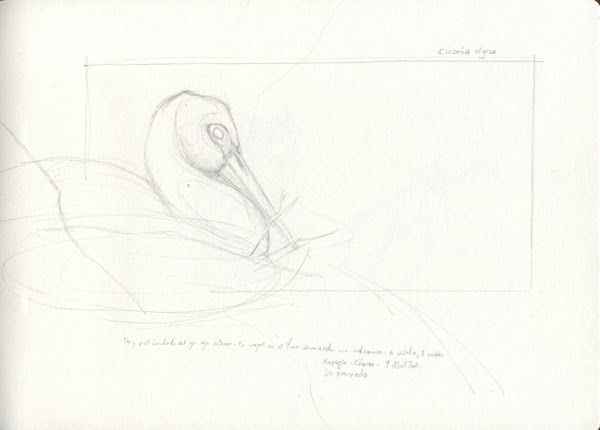
Studies of Black Stork, Ciconia nigra
Graphite pencil on paper, 21 x 29'7 cm.


Last weekend, on the occasion of the opening of Cáceres exhibition, I seized the opportunity to visit the National Park of Monfragüe, a place of great environmental value and of easy access, so much so that the emblematic species of the Mediterranean forest I observed there could be seen from the road which goes through this open space.
Above these lines I show you the morphologic studies of a Black Stork which is incubating opposite "La Fresneda" observation deck. I stayed there for two hours and it only stood up once to turn over the eggs. Its partner didn´t show up.

There was another nest upper this one which offered a beautiful scene; a pity it wasn´t occupied.


Study of Griffon Vulture, Gyps fulvus
Graphite pencil on paper, 21 x 29'7 cm.


Further on, at La Portilla del Tiétar, I could watch a nervous chick of Eagle Owl, Bubo sp, and one of its parents. The cavity they use as home has a group of stones and vegetation like a balcony. It's very close to the Vulture colony at La Portilla. Here I could watch about twenty adult vultures, most of them in their nests, some of them incubating, others looking after their babies... and also some single individuals.
The resulting sketch, above this text, wasn´t as satisfactory as the ones made on the Black Stork at La Fresneda. It was a little bit difficult to concentrate on it as the visitors to the park (relatively quiet) were constantly wandering around because it was easier to watch the vultures breeding.


Studies of Great Crested Grebe, Podiceps cristatus
Graphite pencil and watercolour on paper, 21 x 29'7 cm.


The next day we went to the natural monument of Los Barruecos, in the nearby village of Malpartida de Cáceres.
Everyone who visits this place becomes fascinated with the huge granitic `domos´ and the several nests of White Storks, Ciconia sp, which topped them, ennobling them even more, but I was more attracted by the four couples of Great Crested Grebes swimming in the lake at the foot of the rocky rise. One of the couples was finishing its elaborate courtship but I could only see it once. The other couple, near the shore I was on, was breeding their chicks. I made some drawings studying the morphology of this slender and beautiful bird and then I began to think about making some bronze sculptures.
Without a doubt, a really satisfactory weekend which we´ll try to repeat shortly.

Tuesday, April 5, 2011

Third exhibition of Wildlife Art Cáceres


Fulica atra, 2011
Oil painting on wood, 50x41 cm.


Gallinula chloropus, 2011
Oil painting on wood, 50x24 cm.


Platalea leucorodia, 2001
Etching and aquatint, 18'5 x 9 cm.


Next April 8th at 20.30, the third Wildlife Art Cáceres exhibition will be open at Cáceres Museum - Plaza de las Veletas, 1- in the very historic city center. A beautiful place. The same as last year, a group of members of AEAN will show some of our works. The exhibition will be open till April 24th. I show you the works Juan Varela has chosen. He is the person in charge of the selection of works and the coordination of this event, which is part of the Birds Festival. In next posts I´ll try to show you the process of creation, as I usually do.

Saturday, March 12, 2011

Calamón - Porphyrio sp.


Calamón, Porphyrio sp.
Oil painting on wood, 42x61'5 cm.


Sketch
Graphite pencil on paper, 21x28 cm.

In one of my usual visits to Navaseca Lagoon I was lucky to watch how an adult Purple Swamp-hen was feeding its chick (almost grown-up). The curious thing about it was that it was at the end of November and it was already cold.
The birds were three metres away from my car, which I use as hide. I could make a pencil sketch and take a series of photos which I´m using for this work.
Here are the first steps of the creation process (one more...ha ha)of this painting.

Sunday, February 6, 2011

Good and Bad, equal at the mirror II


Head of pike, Esox lucius
Left size
Galvanized sheet and tin-silver copper, 25x11'5x10 cm.


Head of pike, Esox lucius
upper left side
Galvanized sheet and tin-silver copper, 25x11'5x10 cm.


Head of pike, Esox lucius
Upper view
Galvanized sheet and tin-silver copper, 25x11'5x10 cm.


Head of pike, Esox lucius
Right side
Galvanized sheet and tin-silver copper, 25x11'5x10 cm.


For two years I have been thinking about making a large-scale sculptoric group. I´d like to contrast shapes, materials, concepts…
The group would be composed of an otter, made of wood or bronze and a pike, made of sheet; both of them surrounded by aquatic plants and framed within my characteristic rectangles.

Nowadays I have the time and space needed to approach the project. I don´t know when it will be finished but I have already made the head of the pike… I have to think out the movement of its body and study the pose of the otter. There is still a lot of work to be done. I´ll show you my progress.


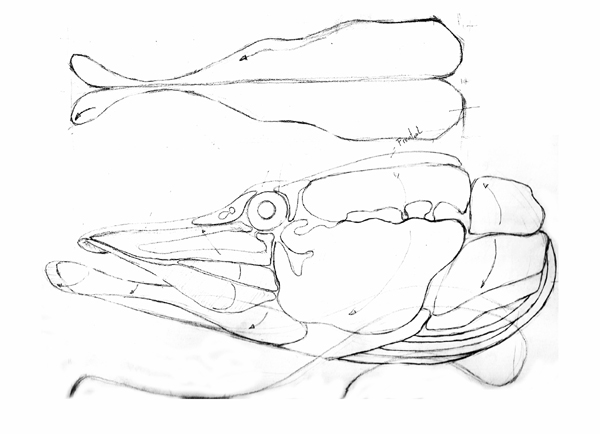
Head of pike, sketch, Esox lucius
Graphite pencil on paper, 42x30 cm.


Otter, sketch -Lutra lutra- made from some pictures taken at the Botanic Zoo in Xerez,
Graphite pencil on paper, 25x25 cm.


Study of the proportions of the pike, Esox lucius
Graphite pencil on paper, 50x25 cm.


Initial sketch of the sculptoric group
Biro on paper, 15x21 cm.

Saturday, January 8, 2011

Tufted Duck - Aythya fuligula


Tufted Duck - Aythya fuligula
Graphite pencil and watercolour on paper, 21x29'7 cm.


Due to flu, I have spent in bed and on the sofa, the time I had the intention of spending painting during Christmas...
Well, one must try to put a brave face on it. I want to show you a work I made some months ago. I drew this Tufted Duck at the `acclimatization pool´ in N.P. of Daimiel; perhaps one of the unfortunately few places where you can always see some birds in this Park.

Monday, December 13, 2010

Common Snipe 2


Common Snipe, Gallinago sp
Oil painting on wood, 30x42 cm.

I´d like to show you the work I had made until, approximately, the `long weekend´in December. I consider the stage of graphite finished. According to Yolanda, it is perfect as it is, and it doesn´t need colour.
December is a bad month for working on the `pencils stuff´, especially if you are a teacher... With long weekends, Christmas dinner, correcting tests and giving marks, you don´t have time for anything.
I think that until this `shopping-production-pollution´ period is over, I won´t be able to go on with it and the other four pictures I´m tied up with.
I would like to take this opportunity to wish you a MERRY CHRISTMAS and suggest that you don´t buy unnecessary things, as every purchase involves some pollution that we could avoid. Our New Year´s Resolution for 2011 could be buying only what we think it is strictly necessary. The reason for all the ills afflicting Our Planet is the excessive consumerism of our society.

Wednesday, November 24, 2010

Common Snipe


Common Snipe, Gallinago sp
Oil painting on wood, 30x42 cm.

As many blogger mates such as Juan Carlos Gálvez, Luis Sogorb, Antonio Ojea... have done, in this post I´ll show you the creation process of a small oil. It is a common snipe - Gallinago sp-. I´m drawing it from a photograph I took at the Navaseca Lagoon in Daimiel, while I´m trying to draw the landscape on site (but the weather is not good). The base of graphite is almost finished and when it isn´t cloudy I´ll try to colour it.

Monday, November 8, 2010

Painting in Doñana


Sketches on site of Avocets, Recurvirostra avosetta
Watercolour and pencil, 29'7 x 21 cm.


Last weekend I travelled to my homeland. I enjoyed it a lot, especially on Saturday. In the morning I was painting with my niece, who made her first `Wildlife Art´work; I enjoyed collaborating on it. Then, after a splendid meal, an afternoon working in one of the most beautiful places to watch birds, the marshes of El Rocío, in Doñana. I was with my colleague of the AEAN: José A. Sencianes. Besides talking about wildlife art, it´s a pleasure to watch how he works... so fluid, quick and, of course, well. Thanks for these moments, mate.


Watercolour made by my niece Aurora(she´s only 4).

Monday, October 11, 2010

Alpine Swift - Apus melba


Alpine Swift, Apus melba
front view
Galvanized sheet, 24x55x4'5 cm.


Alpine Swift, Apus melba
dorsal view
Galvanized sheet, 24x55x4'5 cm.


Nowadays I'm working with metals.I show you the main figure of the sculpture I'm making. It is made of galvanized sheet, embossed and soldered. It still needs the assembly and perhaps I will give it patina.


Details of the work


Previous drawing

Before making the piece I design it to be very clear about the different pieces which compose it.


Creation process